Member participation in the selection of trustees
Member participation in the selection of trustees
Date published: February 2015
| Disclaimer The Pensions Authority have made every effort to ensure that this document is correct. However, no liability whatsoever is accepted by the Pensions Authority, its servants or agents for any errors or omissions in the information contained in this document or for any loss occasioned to any person acting or refraining from acting as a result of the information in this document. © Copyright the Pensions Authority. All rights reserved. |
In this guide you will see certain terms in bold print. These are words or expressions commonly used in relation to pensions or which have a specific definition under the Pensions Act and its regulations. You will find an explanation of these terms in the glossary of terms at the end of the guide.
1. Introduction
The Pensions Authority is the statutory body that supervises compliance with the requirements of the Pensions Act by trustees of occupational pension schemes and trust retirement annuity contracts (RACs), personal retirement savings account (PRSA) providers, registered administrators, employers, key function holders and any other parties subject to the requirements of the Pensions Act. The Pensions Authority also provides guidance on the operation of the Pensions Act and advises the Minister for Social Protection in relation to the Pensions Act and on pension matters generally.
Trustees have overall responsibility for safeguarding the assets of their schemes, for making sure that they are properly invested, that benefits are correctly administered and ensuring that they act in members’ best interests.
Certain members of certain occupational pension schemes have a right to participate in the selection of a number of trustees of their scheme.
The Occupational Pension Schemes (Member Participation in the Selection of Persons for Appointment as Trustees) (No. 3) Regulations, 1996 set out specific rules, processes and procedures in this regard. Giving members the right to participate in the selection of trustees introduces an important additional protection of the rights of scheme members and beneficiaries.
Arrangements for member participation will usually be made following discussions between the employer and representatives of members. These discussions will cover such matters as the overall number of trustees and the arrangements for the selection of a proportion of this number by members.
Members may, alternatively, request the process and this guide sets out the options and procedures involved in the participation of members in the selection of their trustees. It is only an overview, however, and more detailed information is available in the relevant guidance note on the Authority’s website.
General trustee requirements
It should be noted that:
- the criteria set out under section 59A of the Pensions Act regarding the qualifications of trustees must be met,
- a trustee board must collectively have appropriate qualifications, knowledge and experience to carry out their duties which means that, at a minimum:
- at least one trustee on the board must have completed a trustee qualification course listed here, and
- at least one trustee on the board must have been a trustee of a similar type of scheme for at least two of the previous three years.
- all pension scheme trustees must be of good repute and integrity having regard to sections 59A and 64AE of the Pensions Act.
Further guidance on the ‘fit and proper’ requirements for trustee boards is set out in chapter 6 of the Code of Practice for trustees on the Authority’s website, available here.
All trustees are also required to receive training within six months of their appointment and at least every two years thereafter.
2. Eligibility to participate in the selection of trustees
In order to be eligible to participate in the selection of member trustees, a person must be a qualified member of a relevant scheme.
Qualified member
A qualified member means:
- active members – current employees accruing retirement benefits under the scheme, and
- pensioner members – former employees receiving benefits under the scheme, including those for whom an annuity has been purchased.
Former employees who are entitled to deferred benefits under the scheme are not eligible to participate but will be when their benefits become payable.
Pensioners who have not been members but are receiving benefits – widows or widowers of a scheme member, for example – are also not eligible to participate.
Relevant scheme
A relevant scheme is one which has:
- 50 or more qualified members, or
- 12 or more qualified members, if a directly invested scheme.
A directly invested scheme is one which has assets other than the following:
- insurance policies,
- contracts of assurance,
- managed funds,
- unit trusts, and/or
- cash deposits.
For this purpose, unpaid contributions are not treated as assets of the scheme.
The existing trustees of the scheme determine whether the scheme is covered, and which members are eligible to participate.
3. Consultations between employer and members
The legislation does not prohibit the maintenance of any informal trustee arrangement, which provides for some form of member trustee involvement in the scheme, but which is outside the framework of the legislation and does not require the invoking of the legislation.
However, employers and members may wish to have consultations to determine which option is the most appropriate for their scheme. Such consultations will normally take place using the channels in operation in the company for dealing with such issues.
Where the process and selection procedure under the legislation is chosen, the employer and the qualified members jointly have the right to select persons for appointment as trustees under the legislation.
Qualified members of a relevant scheme are free to choose whether to participate in the selection process and the extent to which they wish to participate. If the process is started, the provisions of the legislation override, where necessary, the provisions made in the trust deed and rules of the scheme for the appointment of trustees.
Where the process is started, there are two options for the appointment of member trustees – an election may be held under the ‘standard arrangement’ or it may be that an ‘alternative arrangement’ is proposed. Each of these options are explained in further detail below.
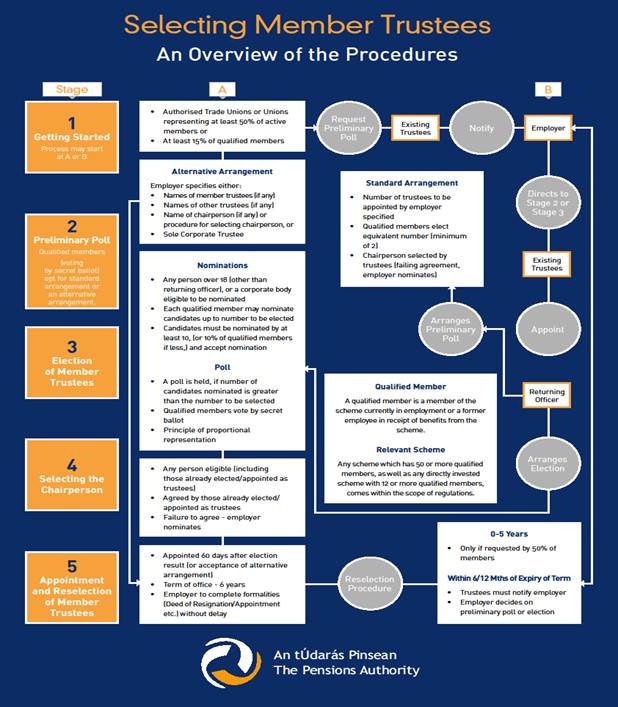
Getting started
The following is a brief overview of the main procedures.
The existing trustees can be requested to start the process by:
- a trade union or trade unions which represent at least 50% of active members, or
- at least 15% of qualified members, or
- the employer.
If the request comes from either (a) or (b), the trustees, on receiving the request, must notify the employer, who then has 60 days to decide whether to propose an alternative arrangement. If they do so, a preliminary poll must be held. If an alternative arrangement is not proposed, an election will be held in accordance with what is referred to as ‘the standard arrangement’. This period of 60 days is designed to give employers time, should they wish to do so, to consult with members on the various options available.
In the case of (c), the employer simply asks the trustees either to hold a preliminary poll or to proceed directly to an election.
Returning officer
Once a valid request to start the process has been received, the trustees will appoint a returning officer who has full responsibility for matters such as the conduct of polls, nomination of candidates, counting of votes, and arrangements for the appointment of new trustees and the chairperson.
The legislation specifies that the returning officer will generally be the company secretary, or the person in the company who performs these functions. The returning officer is not eligible to be nominated as, or to nominate a person for selection as, a member trustee in an election under the standard arrangement.
Preliminary poll
In a preliminary poll (with voting by secret ballot) qualified members are asked whether they wish to opt for either:
- the standard arrangement, or
- the alternative arrangement.
This poll should be completed, and the result notified not later than 30 days after the employer requests that the poll be held.
If 50% or more of the qualified members voting opt for the standard arrangement, the returning officer will hold an election in accordance with that arrangement.
If the majority vote for the alternative arrangement, or if less than 25% of the qualified members vote in the preliminary poll, the alternative arrangement is deemed to be the chosen option.
Standard arrangement
Qualified members may select persons for appointment as trustees from among their own nominees by means of an election.
If an election is to be held, the returning officer will notify the qualified members and invite them to nominate candidates for election.
An election is held in accordance with the standard arrangement, if:
- the employer decides to by-pass a preliminary poll, or
- a majority of qualified members voting in a preliminary poll has chosen the standard arrangement.
Under this arrangement:
- the employer must state the number (but not necessarily the names) of the persons to be nominated for appointment as trustees,
- the qualified members then select, by means of an election, an equivalent number of persons (subject to a minimum of two) for appointment as trustees, and
- the chairperson is chosen by the persons selected for appointment as trustees (both by the employer and members). If a majority of those selected fail to agree on a nominee, the chairperson is chosen by the employer.
Nominations
Anyone over age 18 or a corporate body is eligible to be nominated a candidate. (There are separate requirements regarding eligibility to act as trustees set out in sections 59A and 64AE of the Pensions Act). This means that persons other than scheme members can be nominated. A corporate body is ‘one person’ for these purposes.
To be accepted as a valid candidate for the election, a person must be nominated by at least:
- 10 qualified members, or
- 10% of the qualified members, whichever is the lesser, and
- confirm to the returning officer that they accept the nomination.
Each qualified member may nominate candidates up to the total number to be selected. Thus, if two member trustees are to be appointed, a qualified member may nominate two candidates.
Candidates selected
If the number of candidates nominated is either equal to, or less than, the number of persons to be selected for appointment as member trustees, no poll is held, and the persons nominated are deemed to be selected. If the number of candidates nominated is less than the number to be selected, the employer may nominate a person or persons for appointment as member trustees to make up the difference.
A poll will be held if the number of candidates nominated is greater than the number of persons to be selected for appointment as trustees.
Voting must be by secret ballot and in accordance with the principle of proportional representation, with each qualified member having a single transferable vote.
An election under the standard arrangement must normally be completed and the results notified not later than 90 days from the date the returning officer is required to hold an election in accordance with the legislation.
Alternative arrangement
The employer can put forward the option of an alternative arrangement for the approval of qualified members in a preliminary poll.
An alternative arrangement applies, if:
- it is chosen by a majority of qualified members voting in the preliminary poll, or
- if less than 25% of qualified members vote in that poll.
Under an alternative arrangement there is no election. Instead, in putting forward an alternative arrangement, which would have more than one trustee, the employer must specify:
- the name or names of those person(s), if any, to be appointed as member trustees, to be approved by the members,
- the number (but not necessarily the names) of others, if any, they propose to appoint, and
- either the name of the chairperson, if any, or the procedure proposed for selecting the chairperson.
Sole corporate trustee
In a number of schemes, a corporate body is the sole trustee. The employer may, therefore, wish to propose the retention or adoption of such an arrangement, particularly where some of the directors have been chosen by the scheme members, however if a sole corporate trustee is used under existing arrangements, this cannot be accommodated under a standard arrangement and can only be approved under an alternative arrangement. Also, a sole corporate trustee appointed under an alternative arrangement is not a ‘member trustee’ under the legislation and would not therefore automatically remain in place for the statutory term of six years.
4. Miscellaneous matters
Selecting the chairperson
If an election has been held, those selected for appointment as trustees (by the members and by the employer) are entitled to select the chairperson. If they fail to agree on a nominee, the employer nominates a person for appointment as chairperson. Any person, including those already selected for appointment as trustees, is eligible to be chairperson – however, the chairperson may be nominated in addition to those already selected for appointment as trustees.
If an alternative arrangement has been chosen, the chairperson will be the person nominated by the employer or selected in accordance with any other procedure set down under such arrangement. This person will become a trustee by virtue of their position as chairperson.
The chairperson will have a second (or casting) vote on any issue in the event of a tied vote on any issue for determination by the trustees.
Term of office
The appointment of member trustees will take effect not later than the 60th day after the date on which the returning officer declares them to be selected under either the standard arrangement or alternative arrangement. This means that the employer has 60 days within which to appoint the member trustees by Deed and if they fail to do so on or before the 60th day, the member trustees will automatically be appointed on the expiry of the 60th day.
The term of office of member trustees will expire six years and 60 days after the date of declaration of election results, as will the term of office of the chairperson.
The legislation does not specify any term of office for the trustees (other than a chairperson) nominated by the employer.
Vesting orders by the Authority
The legislation provides that the Authority may make a vesting order, where it considers it desirable to do so, on application to it by a member trustee or a sole corporate trustee of a relevant scheme. The effect of such an order is that legal ownership of certain trust property will vest in the names of all the trustees of the scheme.
Failure of employer to act
If the employer fails to take the necessary action to ensure that the legislation has full effect (by failing, for example, to remove some or all of the existing trustees), procedures are laid down in the legislation to increase the number of member trustees to equal the number of the existing trustees.
Casual vacancies
If a member trustee resigns or dies over 12 months before their term of office expires, a replacement is chosen in the following order:
- where an election has taken place, the person eliminated in the election with the highest number of votes (provided they are willing to accept the appointment),
- in cases where no election has taken place or there are no further candidates available to accept the appointment a person chosen by the remaining member trustees (provided they are willing to accept the appointment).
- if the remaining member trustees fail to choose a replacement, a person chosen by the chairperson (provided they are willing to accept the appointment).
If the vacancy occurs within 12 months of the expiry of the term of office of the trustee concerned, unless the remaining member trustees decide otherwise and notify the chairperson to this effect, the position shall be left vacant until the expiry of the term of office of the trustee.
If the chairperson dies or resigns, the employer selects their replacement.
The term of office of the replacement (member trustee or chairperson) will be the balance of the original term of office.
Re-selection of trustees
If a preliminary poll or an election has taken place, a further poll or election cannot be held within a period of five years, unless at least 50% of the qualified members make a written request to the trustees.
Otherwise, the re-selection process must start six to 12 months before the expiry of the term of office of the member trustees. The trustees are required to start the process by notifying the employer, who will then indicate to them whether they are to hold a preliminary poll or to proceed directly to an election under the standard arrangement. The trustees appoint a returning officer, and the above process is repeated.
Costs incurred/timescales
The costs and expenses incurred by the trustees and the returning officer in relation to an election (including a preliminary poll) may be met from the resources of the scheme.
The timescales set for each stage of the selection process may, in exceptional circumstances, be extended on application to the Authority.
5. Glossary of terms
Active member: A member of a pension scheme who is in ‘reckonable service’, i.e., currently in the employment to which the scheme relates, and who is building up retirement benefits.
Assets: The property, investments, cash and other items of which the trustees of a pension scheme are the legal owners.
Beneficiary: A person who is entitled to benefits under a pension scheme or who will become entitled on the happening of a specified event (e.g., on the death of a member).
Member: A person who has been admitted to membership of a pension scheme and who remains entitled to benefits under the scheme. This includes active members, deferred pensioners and pensioners.
Member (selected) trustees: A person selected by qualified members for appointment as a trustee in accordance with the ‘standard arrangement’ or a person whose selection is approved by qualified members for appointment as a trustee in accordance with the ‘alternative arrangement’ or a person selected to fill a vacancy in accordance with the ‘casual vacancies’ provisions.
Occupational pension scheme: A scheme set up for employees which provides either or both of the following benefits:
- retirement benefits for members,
- death benefits for the dependant(s) of members.
Pensions Act: The Pensions Act, 1990, as amended, is the principal piece of pensions legislation in Ireland and has been considerably amended and extended since 1990.
Pensioner member: A person being paid from a pension scheme (also called a pensioner).
Qualified member: In relation to the member trustee selection process, an active member or a pensioner (but not a deferred pensioner or a dependant or other beneficiary receiving payments from the scheme). Qualified members may vote in a preliminary poll or an election organised for the purpose of selecting new trustee(s) of a relevant pension scheme.
Relevant scheme: In the context of the ‘member participation in the selection of trustees regulations’, a scheme established under a trust and which has not less than 50 qualified members or is a directly invested scheme which has not less than 12 qualified members provided that an external scheme shall not be a relevant scheme if external members comprise not less than 20% of the total number of persons who, having been admitted to membership under the rules of the scheme, remain entitled to any benefit under the scheme.
Trust: To qualify for full tax approval, funded pension schemes must normally be set up as irrevocable trusts. A trust is an arrangement under which a person or a group of people (trustees) hold and look after property on behalf of others. The property is called a trust fund and the people on whose behalf the trust fund is held are called beneficiaries. In the case of a pension scheme set up as a trust, the assets are held by the pension scheme trustees for the benefit of the members and beneficiaries of the pension scheme.
Trustee: In the context of pension schemes means an individual or a company which alone, in the case of a company, or jointly becomes the legal owner of assets to be administered for the benefit of pension scheme members and beneficiaries in accordance with the provisions of the document creating the trust, the provisions of trust law generally and the Pensions Act which is overriding. Since the second EU pensions directive was transposed, the Pensions Act requires there to be a minimum of two trustees for each pension scheme, or two directors in the case of a sole corporate trustee.
6. An overview of the procedures